
Why a 7-Day Itinerary in Greater Yellowstone Still Matters
The Greater Yellowstone Ecosystem is one of the last large, nearly intact temperate ecosystems on the planet. It spans two major national parks—Yellowstone and Grand Teton—plus a mosaic of national forests, ranch lands, and western towns that live in constant dialogue with wildlife and tourism.
Whenever I travel there, I’m struck by a double reality: this is an extraordinary place that absolutely deserves its reputation, and at the same time it’s fragile, crowded in peak season, and under pressure from climate change and development. A well-planned 7-day itinerary is not just about ticking off sights; it’s an opportunity to travel more slowly, make thoughtful choices, and reduce your footprint while still enjoying geysers, bison jams, and cowboy cafés.
Here’s a detailed 7-day route I recommend for a first trip to the “Grand Yellowstone” region: a mix of must-see icons, less-trafficked corners, and a focus on sustainable practices along the way.
Best Time to Visit and How to Travel Responsibly
If your dates are flexible, I personally favor late May–June and September–early October. Wildlife is active, temperatures are milder than in mid-summer, and the crowds thin out a bit. July and August are still magical, but you’ll share viewpoints and trails with many more people, and road congestion is a real issue around Old Faithful and the Grand Canyon of the Yellowstone.
To travel more responsibly in Greater Yellowstone:
- Travel outside peak hours: Start early in the morning and enjoy evenings out on the road; midday is both the busiest and the most stressful time for wildlife and rangers.
- Stick to existing infrastructure: Stay on trails, boardwalks, and pullouts. Off-trail shortcuts might look harmless but can damage delicate thermal areas and vegetation.
- Minimize car use when possible: Carpool if you’re in a group, limit daily backtracking, and plan loops rather than out-and-back drives.
- Support local and sustainable businesses: Choose lodges, outfitters, and restaurants that emphasize conservation, local sourcing, and fair employment.
- Keep your distance from wildlife: At least 100 yards from bears and wolves, 25 yards from other animals. A good rule: if you’re changing the animal’s behavior, you’re too close.
Day 1: Arrival in Jackson and First Taste of the Tetons
Flying into Jackson Hole Airport sets the tone immediately: you land right in Grand Teton National Park, with the jagged skyline of the Tetons framing the runway. If you can, arrive by midday to give yourself time for a gentle first afternoon.
After settling into your lodging in Jackson or within the park, I like to keep the first day light:
- Visit the Town Square: The iconic elk-antler arches are touristy but charming; beyond the photo op, look for local art galleries that feature conservation photographers and regional artists rather than mass-produced souvenirs.
- Short hike or lakeside stroll: String Lake or the southern shore of Jenny Lake are ideal for getting familiar with the Teton landscape. Stay on marked trails; this is prime bear habitat.
- Evening in Jackson: Yes, Jackson has a polished, upscale feel, but it’s also a gateway community deeply tied to public lands. I recommend choosing a restaurant that sources regionally (many now highlight this on their menus).
From a sustainability perspective, Jackson is one of the region’s most active communities for recycling, public transit, and conservation nonprofits. It’s a good place to stock up at supermarkets with bulk sections, reusable containers, and refillable water before heading deeper into the parks.
Day 2: Grand Teton National Park Highlights
Devote a full day to Grand Teton before heading north. In my view, this is one of the most photogenic and surprisingly less crowded parks in the system, especially if you walk just a little bit away from the parking lots.
My ideal route for the day would be:
- Sunrise at Mormon Row or Schwabacher Landing: Both offer classic Teton views with softer light and fewer people. Be mindful of private land around Mormon Row.
- Jenny Lake area: Either hike the lakeshore or take the shuttle boat and walk up to Hidden Falls and Inspiration Point. The trail can be busy, but it’s a deserved classic. Bring your own water and snacks to reduce packaging waste.
- Scenic drive via Oxbow Bend and Jackson Lake: Oxbow Bend at dusk is one of my favorite wildlife-watching spots in the entire region—moose, elk, and occasionally bears and otters. Stay quiet and patient; use binoculars rather than creeping closer.
Night two can still be in Jackson or, if you prefer shorter driving distances, near Moran or within one of the park lodges (booking early is essential). I personally like staying in or close to the park at least one night—it keeps you closer to sunrise and sunset light without long commutes.
Day 3: From the Tetons to Yellowstone’s Old Faithful
Today you enter Yellowstone proper. I recommend heading north via the John D. Rockefeller Jr. Memorial Parkway, watching as the Tetons recede and the Yellowstone Plateau opens up.
On the way to the Old Faithful area, make time for:
- West Thumb Geyser Basin: Overlooked by many, this small thermal area sits right on the edge of Yellowstone Lake. The contrast between hot springs and the cold, deep blue water is striking.
- Short lakefront stop: Pullouts along Yellowstone Lake offer wide-open spaces with fewer crowds; they’re a good spot for a picnic with reusable containers.
By mid-afternoon, reach the Old Faithful area. It’s undeniably busy, but in my opinion the Upper Geyser Basin is still one of the most impressive geothermal areas on Earth.
- Old Faithful eruption: Check the posted prediction times at the visitor center. Watch from a bit farther back or on the boardwalks rather than the first row; the view is just as good, and you’ll avoid the densest cluster of people.
- Walk the Upper Geyser Basin boardwalks: Don’t just see Old Faithful and leave; give yourself 2–3 hours to wander among Castle, Grand, Riverside, and the countless smaller pools and vents.
If available, stay at the historic Old Faithful Inn or nearby lodges. The Inn, with its timber-frame lobby, is atmospheric and allows you to explore in the early morning and late evening when tour buses are gone.
Day 4: Geysers to Grand Canyon of the Yellowstone
On day four, follow the park’s “lower loop,” making your way gradually toward the Grand Canyon of the Yellowstone.
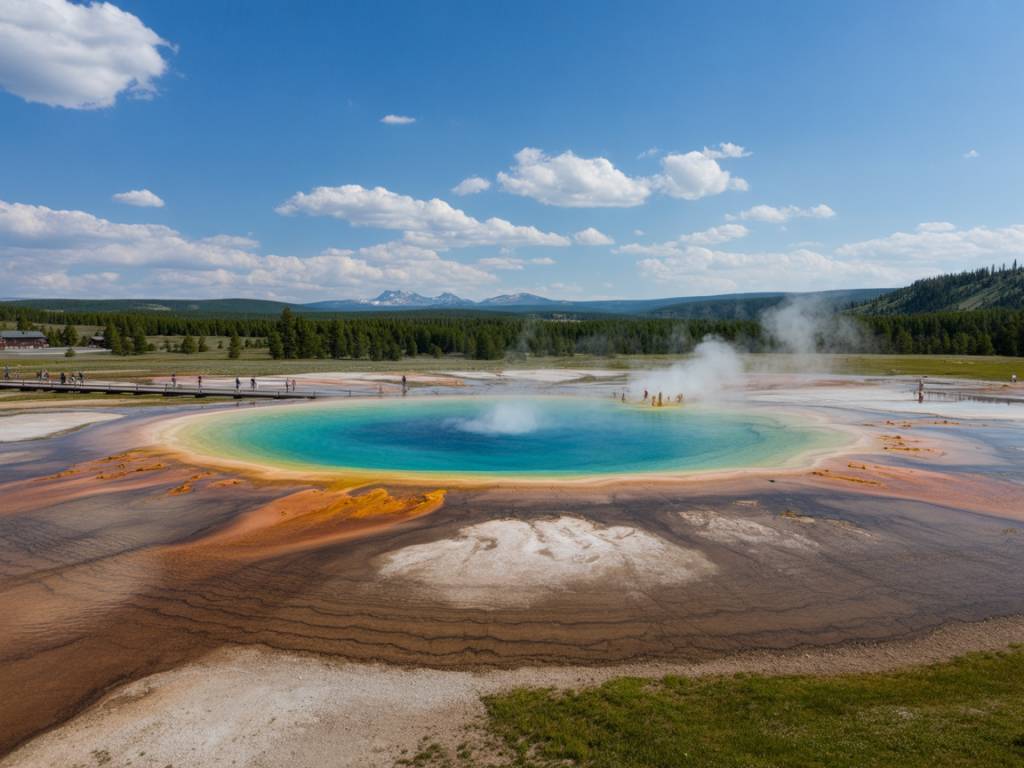
- Midway Geyser Basin and Grand Prismatic Spring: But go early. Parking is limited and the boardwalk becomes congested mid-morning. For a more expansive view, the Fairy Falls trail offers a popular overlook; stay on the designated spur.
- Norris Geyser Basin: I have a soft spot for Norris. It feels more chaotic and dynamic, with an otherworldly palette of whites, greens, and blues. The boardwalks can be long; give yourself time.
- Grand Canyon of the Yellowstone: Head for Artist Point on the South Rim first; it’s crowded but spectacular. Then consider a short hike such as the South Rim Trail or the North Rim viewpoints, depending on your energy.
Overnight options include Canyon Village (very central for exploring) or lodging at Lake or even back toward Norris. From a sustainability perspective, Canyon’s central location means less daily driving, which I find a big plus.
Day 5: Hayden Valley, Lamar Valley, and Wildlife Watching
This is your wildlife day, and for me it’s one of the most memorable parts of any Yellowstone trip. Set the alarm early; dawn and dusk are the best times to see animals and to avoid traffic.
- Sunrise in Hayden Valley: Bison herds, elk, waterfowl, and occasionally wolves and bears. Use pullouts and keep your car ready to move—bison jams are common but temporary. Never walk into the meadows for a closer view.
- Drive to the Lamar Valley: Often called “America’s Serengeti,” it’s the best place in the park for wide-open vistas and wolf watching, especially with a spotting scope. If you’re new to wildlife spotting, consider joining a small-group tour with a naturalist; they tend to use shared vehicles and emphasize respectful viewing.
In terms of personal preference, I would trade an extra geyser basin visit for more time in Lamar any day. The sense of space and the sight of pronghorn and bison moving across the valley floor feel like a glimpse of pre-settlement North America.
Stay the night in Cooke City or Silver Gate just outside the Northeast Entrance, or back in the park at Roosevelt or Canyon. Cooke City and Silver Gate are small, authentic mountain communities; supporting locally-owned motels and cafés here has a direct impact on residents who live with wildlife year-round.
Day 6: Over the Beartooth or Chief Joseph Highway to Cody
Leaving the northeast side of Yellowstone, you have two fantastic scenic drives, both worthy from a journalist’s eye and a traveler’s heart.
- Beartooth Highway (US-212): My preferred route when it’s open (usually late May to October). It climbs above 10,000 feet, with tundra, alpine lakes, and sweeping switchbacks. It’s not fast, and that’s the point—pull over often and take short walks away from the road, staying on durable surfaces like rock.
- Chief Joseph Scenic Byway (WY-296): A bit less dramatic in elevation but rich in history and big western landscapes tied to the story of the Nez Perce.
Both routes eventually bring you toward Cody, Wyoming, one of the most classic “western” towns in the region. Cody leans into its cowboy branding, but it’s also a place to explore the more complex narratives of the American West.
In Cody, I recommend:
- Buffalo Bill Center of the West: A serious museum complex, not a tourist trap. With multiple wings—from natural history to Plains Indian cultures—it provides important context for the landscape you’ve just driven through.
- Historic downtown: Look beyond the gift shops for locally owned cafés and bars that serve as community hubs.
Spend the night in Cody. Compared to strictly park-based lodging, Cody often has more options to choose businesses that emphasize energy efficiency, local hiring, and regional products. Ask a few questions at check-in; it signals that visitors care about these issues.
Day 7: Return to Jackson via the Buffalo Bill Scenic Byway
On your final day, begin the journey back toward Jackson (or another departure point), but resist the urge to rush. The road from Cody to Yellowstone’s East Entrance—the Buffalo Bill Scenic Byway—follows the North Fork of the Shoshone River through rugged volcanic country and prime wildlife habitat.
Depending on your flight schedule or drive home, you can:
- Stop again in Yellowstone Lake area: A brief walk along the shoreline or a visit to the Lake Hotel offers a calmer farewell than Old Faithful’s crowds.
- Take a final Teton detour: If time allows, re-enter Grand Teton National Park for one last look at the mountains from a pullout like Snake River Overlook.
By the time you roll back into Jackson, you’ll have driven a large loop through some of the most storied terrain in the American West: geyser basins, wolf country, alpine passes, and towns that are still negotiating their relationship with tourism and wild nature.
Final Thoughts on Traveling Well in Greater Yellowstone
Over seven days, you can’t see everything in this region, and you shouldn’t try. The trips I remember best are the ones where I slowed down at a few places instead of rushing to many, where I stayed a little longer at dawn in Lamar, or talked with a local guide in Cody about winter elk migrations and water shortages.
If there’s one guiding principle I’d leave you with, it’s this: treat Yellowstone and its neighboring lands as a living, evolving place, not a theme park. Choose smaller-group activities, time your visits to relieve pressure on rangers and wildlife, spend money with businesses that give back locally, and always, always keep a respectful distance from animals. Done this way, a 7-day itinerary in the Grand Yellowstone region becomes more than a vacation—it’s a way to participate, however modestly, in the long-term story of a unique ecosystem.